Should your wine ratings be private? Why other people's scores change yours
Research shows that seeing other people's scores nudges your own. Here's why private wine ratings give you a more honest read on your taste.
 Reviewed by Marcus Henningsson, Head Sommelier
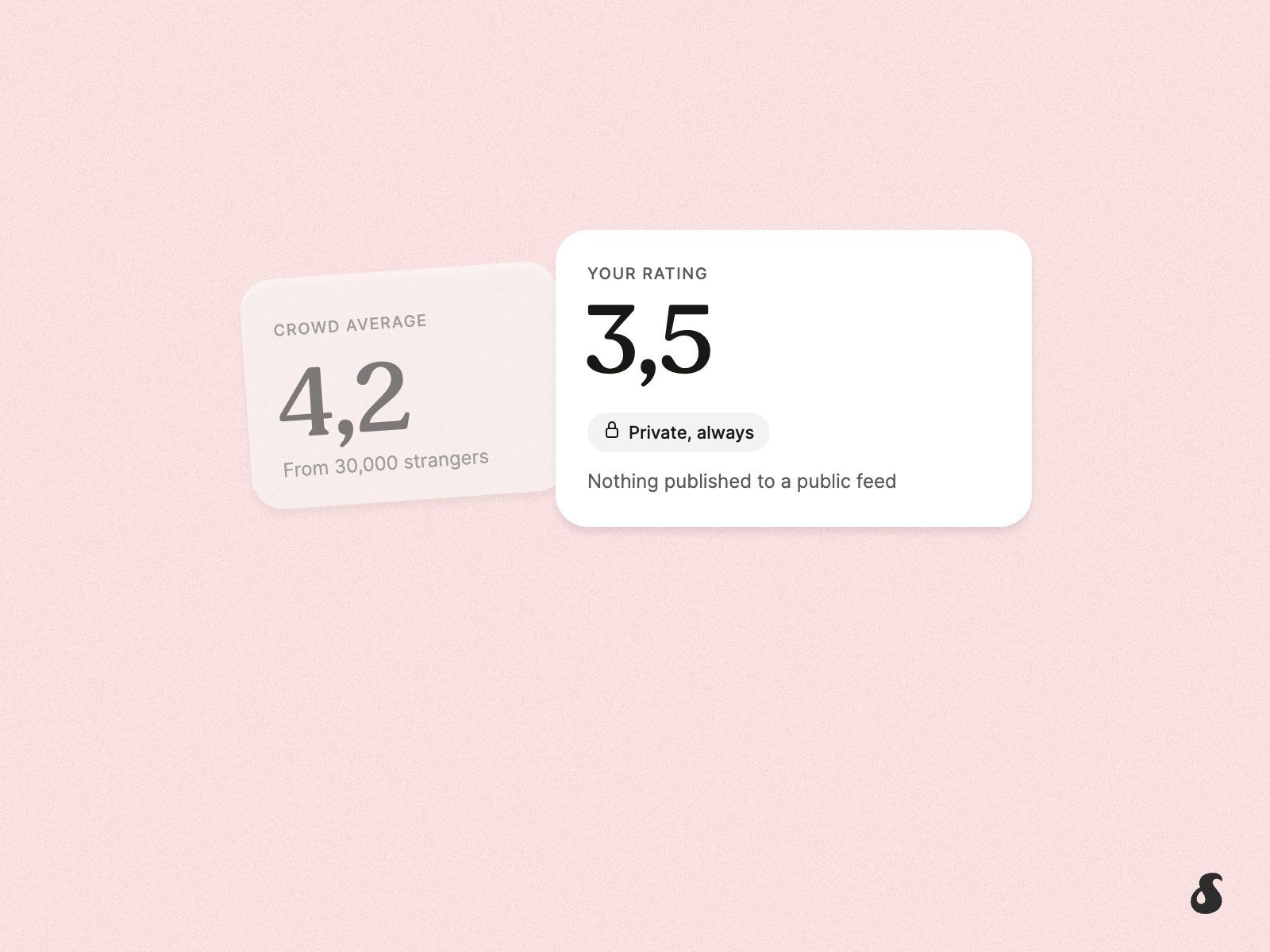
You open the app, scan the bottle and, before you've even taken a second sip, there it is: 4.2 from thousands of people. Now you have to rate it. Do you give it the 3 you were leaning towards, or does the crowd's number make you wonder if you missed something? That small moment is why private wine ratings matter more than most people think. The question isn't whether your opinion is right. It's whether it's still yours once you've seen everyone else's.
Do other people's ratings really change your own?
Yes, and the effect is measurable. In 2013, researchers ran a five-month randomised experiment on a news-sharing site, quietly giving 101,281 comments an extra positive vote at random. Those comments were 32% more likely to get a positive rating from the next reader, and ended up with an average rating 25% higher than comments left alone. The study, published in Science, called this social influence bias: an early signal pulls later judgements along with it.
Wine isn't a news comment, but the mechanism is the same. When you rate a bottle in public, or next to a big public average, you're not rating in a vacuum. You're rating in conversation with a number that arrived first.
Does knowing the price or score change how wine tastes?
It can change how much you enjoy it, which is what a rating records. In a well-known 2008 Caltech and Stanford study, 11 participants tasted Cabernet Sauvignons labelled only by price. The same wine was served twice, once tagged at $5 and once at $45, and participants said the "more expensive" glass tasted better. Brain scans showed more activity in an area linked to experienced pleasure when the price was higher.
A public score works like that price tag. It sets an expectation before the wine reaches your glass, and expectation shapes experience. If you want to read more about how much price really tells you, we've covered it in does price indicate wine quality?
If even experts are inconsistent, does my rating matter?
Here's the reassuring part. A study of judges at a major US wine competition gave panels the same wine three times in one flight, poured from the same bottle. Only about 10% of judges scored all three within a single medal group. Another 10% sometimes scored the same wine anywhere from bronze to gold.
That isn't a reason to give up on rating. It shows that a single score, from anyone, is a noisy snapshot. What makes ratings useful is many honest ratings from one palate over time. The pattern is what tells you something, and patterns only hold if each data point reflects what you actually thought.
Why private wine ratings give you a more honest taste profile
Rating in public quietly turns tasting into a performance. You might bump a famous bottle up because it's supposed to be good. You might hold back from admitting you love a cheap, fruity rosé. You might skip rating the wines you didn't like because a low score feels harsh. Each choice makes sense in the moment, and each one bends your record away from your real taste.
Private wine ratings remove the audience. Nobody sees your 2 out of 5 for the critics' darling, so you can just write it. Over a few dozen bottles, that honesty adds up to something genuinely useful: a record of what you like, not what you thought you should like.
If you've already started keeping notes, our guide to building a personal wine journal covers what to record. This article is about the other half: making sure the scores in that journal aren't secretly someone else's.
Are low ratings worth recording too?
Absolutely, and privacy makes them much easier to give. A wine you disliked tells you just as much as one you loved. If you keep marking down heavily oaked whites or high-alcohol reds, that's a clear signal about your palate. In a public setting, people tend to leave those ratings out. In private, they're simply information.
How do public rating apps differ from private ones?
Most popular wine apps are built around a public average: many people rate a wine, and you see the mean. That average can tell you a wine is broadly well liked. It can't tell you whether you will like it, which is the only question that matters when you're standing in the aisle. And because the average is visible before you rate, it shapes your score too. We've gone deeper on this in why crowd-sourced wine ratings don't always help you choose.
Swirl is built the other way round:
- Your ratings and tasting notes are private by default. Nothing is published to a public feed. They're used only to improve your own recommendations.
- Your ratings build your taste profile. You set a baseline with a short taste questionnaire when you sign up, and every wine you rate refines it. Only rated wines affect your recommendations, so scanning or saving a bottle won't skew them.
- Dislikes count as much as loves. A low rating is just as valuable to your profile as a high one.
- Matches are personal, not popular. When you scan a label, Swirl shows how close the wine is to your taste across things like colour, body, intensity, price and climate, rather than showing you a crowd score to live up to.
- The wine facts come from producers. Grape, region and style details come from producer spec sheets, so your profile is built on reliable information rather than public guesswork.
Read more about how that profile works in why a wine taste profile app matters.
What private ratings can't do
Being honest about the limits matters. A private rating is only as good as the attention you give it. Rate a wine after a long day, with spicy food or in a noisy bar, and the setting will colour your score. A quick note about the context helps future you read it fairly.
Privacy also means you won't get the reassurance of a crowd. If you like checking that a bottle is broadly popular before buying it for a group, a private profile won't give you that. What it gives you instead is a growing, honest picture of your own taste. And your profile needs ratings to learn: a handful of bottles is a start, a few dozen is where the patterns get sharp.
How to rate wine honestly, starting tonight
- Rate before you look. Decide your score before checking any reviews or prices online.
- Use the whole scale. If you didn't enjoy it, say so. Low scores are useful data.
- Write one line in your own words. "Too sharp on its own, great with the cheese" beats a borrowed tasting note.
- Note the moment. The food, the company and the setting all help you read the score later.
- Rate everything you'd want to remember, not just the wins. That's how the pattern appears.
Ready to find out what you actually like?
You don't need to agree with the crowd to drink well. You just need an honest record of your own taste and a way to connect it to the next bottle. Swirl keeps your ratings private and turns them into recommendations built around your palate.
Frequently asked questions
Are my wine ratings public on Swirl?
No. Your ratings and tasting notes are private by default. They're used to improve your own recommendations, not published to a public feed.
Do other people's ratings really affect my own?
Research suggests so. A 2013 randomised experiment published in Science found that items given an early positive vote were 32% more likely to get a positive rating from the next person, and ended up with an average rating 25% higher.
Should I rate wines I didn't like?
Yes. Low ratings tell your taste profile just as much as high ones, and keeping them private makes them easier to record honestly.
Is a crowd average useless?
No. It can show that a wine is broadly well liked. It just can't tell you whether you'll like it, which is what your own ratings are for.
Sources
- Muchnik, Aral & Taylor (2013), "Social influence bias: a randomized experiment", Science – PubMed
- ScienceDaily: "Online ratings: herd mentality" (2013), summary of the Science study
- Plassmann et al. (2008), "Marketing actions can modulate neural representations of experienced pleasantness", PNAS – PubMed
- Stanford News: "Wine study shows price influences perception" (2008)
- Hodgson (2008), "An examination of judge reliability at a major U.S. wine competition", Journal of Wine Economics
- Swirl: app features and FAQ

Article reviewed by
Marcus Henningsson
Head Sommelier
Marcus is our Head Sommelier with experience in highly regarded places including 1, 2 and 3-Michelin-starred restaurants. With over 10 years of experience, he's passionate about helping people having unforgettable wine experiences.